
How I Started Homeschooling

Updated: May 8
When I talk to new homeschool parents, I hear the same thing over and over:“I want to homeschool… but I have no idea where to start.”
I felt the same way. When I first stepped into homeschooling, it felt like walking into a whole new world with no map, no guide, and no clue what I was doing. But over time, I learned something important: starting homeschool doesn’t have to feel scary. It can feel calm, simple, and even fun when you break it down into clear steps.
This is the guide I wish someone had handed me on day one. My goal is to help you feel confident, steady, and ready to begin.
📝 1. Start With the Legal Basics
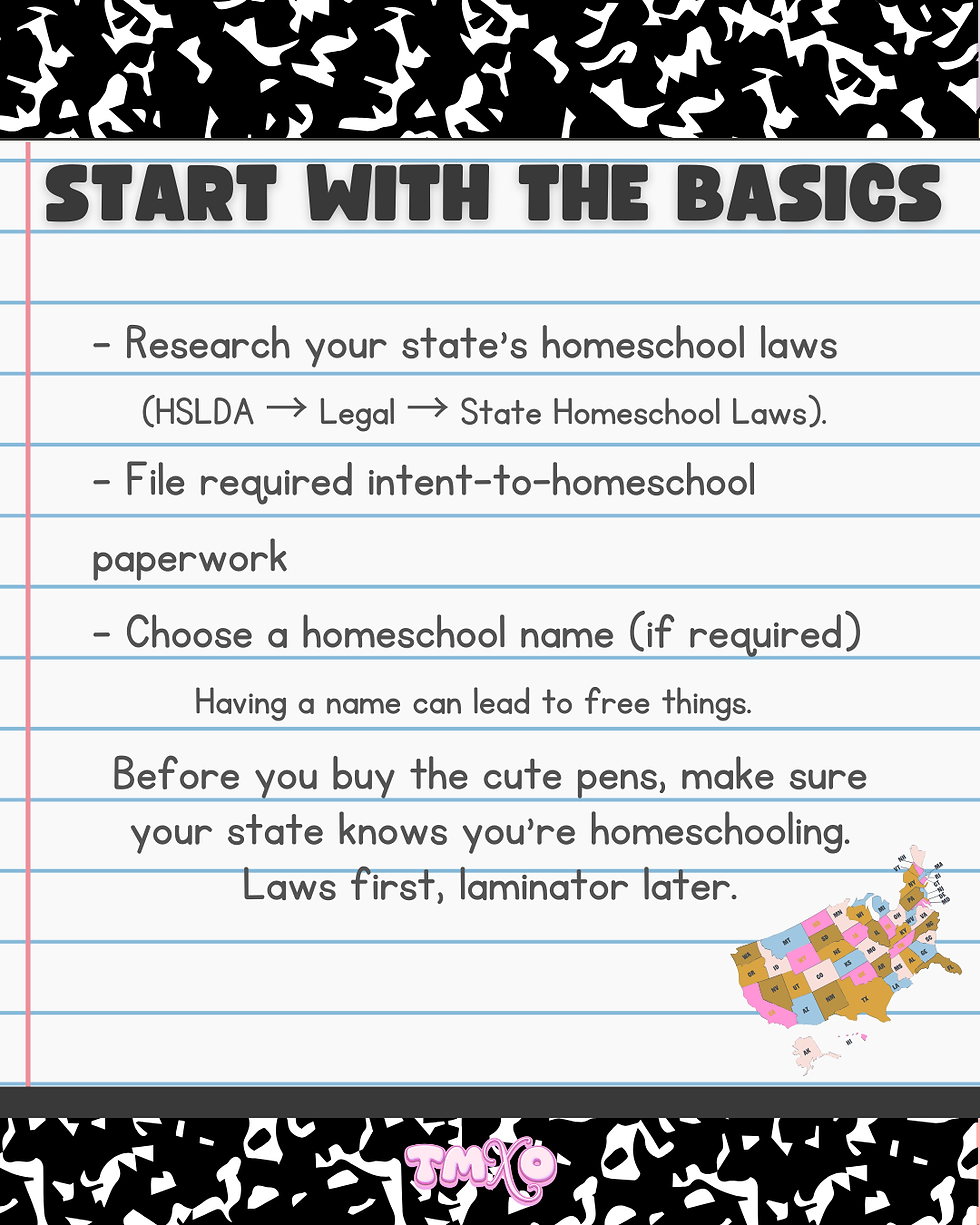
Before you buy a single workbook or set up a cute shelf, you need to know your state’s rules. Every state is different. Some want paperwork. Some want attendance. Some want testing. Some want nothing at all.
Here are the first things I always tell parents to do:
Research your state’s homeschool laws (HSLDA → Legal → State Homeschool Laws).
File any required intent‑to‑homeschool paperwork. I did this by google searching homeschool and the district we were zoned to and if that didn't work I Google seached my state + intent-to-homeschool.
Choose a homeschool name if your state requires one. I chose a name because when you create a id card with the school name I get free things. Muah ha haaaaa
These steps don’t take long, but they give you a strong, confident start.
🏡 2. Build Your Homeschool Foundation
Once the legal stuff is done, you can start shaping what your homeschool will look like. This part is actually fun.
I learned quickly that my homeschool didn’t need to look like a magazine spread. It didn’t need matching bins or a giant chalkboard wall. It just needed to work for us. A small table, a shelf, and a basket of supplies were enough.

Here’s what helped me build a strong foundation:
Set up a dedicated learning space (functional > fancy).
Decide on a schedule style (year‑round, 4‑day week, traditional, block schedule).
Choose your homeschool style (Charlotte Mason, Classical, Montessori, Waldorf, Unschooling, Unit Studies, Eclectic, etc.).
Identify your child’s learning style (visual, hands‑on, auditory, mixed). This isn't a neccessity but it gives you an idea different approaches you can take with your child.
Reflect on your teaching style and what feels natural for you. What feels natural to me is letting my student productively struggle through the task and I'm there to offer support or answers to their questions. I personally believe that breathing down their neck stresses us all out.
Choosing a homeschool style was a big moment for me. I didn’t even know homeschool styles existed at first. I ended up choosing Eclectic because it gave me freedom to mix what worked and ignore what didn’t. I could easily plug in what I like in my ORBIT framework. I used what I did in the classroom for 15 years and turned into a framework that I use to blend seamlessly into my everday while homeschooling my five kids that are all standing on different developmental planets.
📚 3. Plan Your Learning Without Overwhelm

Choosing curriculum used to stress me out. I thought I had to pick the “perfect” one. But the truth is, there is no perfect curriculum. There is only what works for your child right now. Plus, I change curriculum like I change underwear so I use my new framework that doesn't tie me down to ONE single curriculum! I compile a list of free resources that I use to plug in what I need to enhance my childrens' learning. I'm constantly updating it with new things that I find.
Here’s how I learned to plan without losing my mind:
Choose a curriculum or blend your own
Plan your first 4–6 weeks with flexibility and low pressure.
Gather materials (books, manipulatives, tech tools, printables).
Create a simple record‑keeping system (attendance, work samples, progress notes).
Choose how you’ll track progress (checklists, portfolios, ORBIT reflections).
Crazy part, your state may not even need you to keep records, but I suggest keeping them anyway in case you may need to pivot and send your kids back to a school. Better to be safe than sorry.
I kept everything simple. A folder for work samples. A notebook for notes. A short checklist for progress. A Google spreadsheet for attendance and grades. That’s it.
🌱 4. Find Community and Support
Homeschooling alone is hard. Homeschooling with community feels completely different.
I joined local groups, online groups, and found a few parents who had been doing this longer than me. They answered questions, shared ideas, and reminded me that the chaos I felt was normal.

Here’s what helped:
Join local and online homeschool groups. Join the TMXO Homeschool Collective!
Find a mentor or experienced homeschool parent.
Plan social opportunities (co‑ops, clubs, sports, library events).
Homeschooling doesn’t mean staying home all day. It means learning everywhere.
🧠 5. Build Routines That Fit Real Life
One of the biggest lessons I learned was to set expectations that matched real life—not Instagram life.
Some days go great.
Some days fall apart.
Some days you get a full lesson done.
Some days you count a nature walk as science and call it good.
Here’s what kept me steady:
Set realistic expectations for yourself and your kids.
Build in breaks, rest days, and catch‑up weeks.
Establish family routines and boundaries (screen time, quiet time, chore flow).
These routines kept our home running and kept me from burning out.
🎉 6. Celebrate the Quiet Wins
Homeschool progress is quiet. It doesn’t always look big or dramatic. Sometimes it’s a kid reading a word they couldn’t read last week. Sometimes it’s a math problem solved without tears. Sometimes it’s a day where everyone stayed calm.
These moments matter. They build confidence. They remind you that homeschooling works, even when it feels messy.
Celebrate every small win — because
homeschool progress is quiet but powerful.
❤️ Final Thoughts
If you’re standing at the starting line of homeschooling — heart racing, tabs open, wondering if you’re about to ruin your child or accidentally join a cult — breathe. You’re in the right place. And before you buy a single curriculum bundle or convince yourself you need a farmhouse‑white schoolroom with matching bins, I want you to have something that actually helps.

It’s my book, The Anti Perfect Homeschool — and I wrote it for the parent who is starting exactly where you are: hopeful, overwhelmed, curious, and maybe a little bit convinced everyone else got a secret manual.
This isn’t a “do it my way” book. It’s a “you’re not broken, the system is loud, and here’s how to build something that fits your real life” book. It’s warm, honest, ADHD‑friendly, and built for parents who want homeschooling to feel human, not performative.
If you’re beginning your homeschool journey and you want clarity without pressure, encouragement without fluff, and a guide that feels like a real person talking to you — this is it.


Comments