
A Long, Honest, Slightly Sarcastic Love Letter to the Homeschool Parent Who’s Tired of Pretending

Updated: Jul 18
Let me start with this: transitioning from being a classroom teacher to a homeschool mom was not a gentle, graceful pivot. It was not a “calling.” It was not a peaceful, faith-filled moment where I said, “Yes, Lord, I will shepherd my children’s hearts.”
No.
Mind you, I'm a secular homeschooler.
It was like getting thrown in front of a bus. A big one. With no warning. And definitely no seatbelt.
One minute, I was a math interventionist with data binders, intervention groups, and a rolling cart that made me feel powerful. The next minute, I was in North Dakota, pregnant with twins, homeschooling my kids in a climate that actively tried to kill me every winter.
And here’s the kicker: I didn’t have a guide. Not a real one. Not one that told the truth about what homeschooling actually feels like. Not one that understood the chaos, the identity crisis, the “what am I even doing,” the toddler climbing the furniture, the curriculum that made me cry, or the days where I questioned every life choice that led me here.
I had nothing but vibes, survival instincts, and a Google search history that would concern a licensed professional.

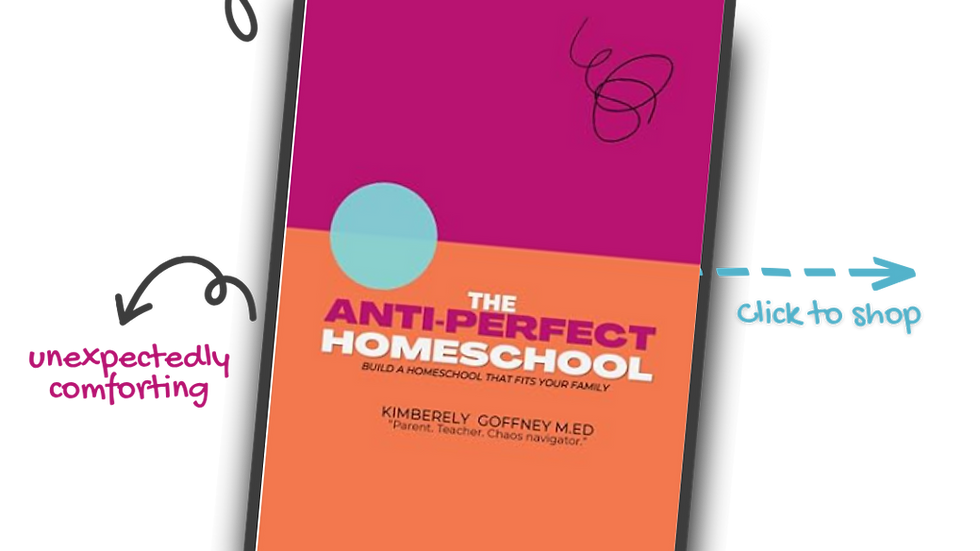
That’s why I wrote The Anti-Perfect Homeschool Book and The Anti-Perfect Homeschool Journal. Not because I figured everything out. Not because I’m the guru of calm, peaceful homeschooling. Not because my kids sit quietly at the table like a stock photo family.
I wrote them because I needed them. Desperately. And they didn’t exist.
These two books are the guide I wish someone had handed me when I was standing in my kitchen, holding not one but TWO newborns, staring at a math workbook, managing my ADHD, and wondering if I had accidentally ruined my children’s entire future.
Let me tell you a secret I wish someone had told me before I started homeschooling: most of us are out here doing the best we can with a questionable amount of sleep, a rotating cast of snack-related emergencies, and a child who suddenly forgets how to hold a pencil every time we sit down to “do school.”
And yet… we still think we’re supposed to be perfect.
Perfect routines. Perfect curriculum choices. Perfect attitudes. Perfect children who never melt down during math or scream “I HATE READING” loud enough for the neighbors to hear.
It’s adorable, really, the way we think we’re supposed to hold it all together.
I'm here to tell you that homeschooling isn't perfect. It’s human. It’s messy. It’s beautiful. It’s loud. It’s honest. It’s a relationship, not a performance.
And that’s exactly what these two books are built to support.
The Anti-Perfect Homeschool Book: The Book I Needed When I Started

This book is the opposite of every “How to Homeschool in 47 Easy Steps” guide you’ve ever seen.
It’s not a system. It’s not a curriculum. It’s not a schedule. It’s not a list of things you “should” be doing.
It’s a grounding, honest, deeply human guide that helps you:
Understand your child without comparing them to anyone else.
Build a rhythm that fits your actual life.
Stop trying to recreate school at home.
Release the guilt that’s been sitting on your chest.
Trust yourself more than the internet.
Breathe again.
It’s the book I wish someone had handed me when I was drowning in curriculum samples, Pinterest boards, and the crushing fear that I was going to ruin my kids.
Spoiler: you’re not ruining your kids. You’re raising them. There’s a difference.
The Anti-Perfect Homeschool Journal: The Companion for the Real Days

The journal is where everything from the book starts to take shape in your actual life. It’s where the ideas stop being ideas and start becoming something you can see in your rhythms, in your child, in your home, in yourself. It’s not a planner pretending to keep you organized. It’s not a tracker waiting for you to fill in boxes you’ll abandon by midweek. And it’s definitely not a place to write down 87 goals you’ll forget about by Thursday.
It’s quieter than that. More honest than that. More human than that.
The journal is a space to pause long enough to actually notice what’s happening in your home. That includes the good, the hard, the surprising, the “why is everyone crying” moments, and the tiny wins you’d normally rush past. It’s a grounding place, a reflection place, a “let me actually think about this before I spiral” place.
As you move through it, you start to see things you didn’t realize were there: what’s working, what’s not, what your child’s energy is telling you, what your energy is telling you, and how to build a rhythm that doesn’t collapse by 9:17 AM. It gives you a way to reset without burning everything down, and a way to close your homeschool year with clarity instead of panic.
This journal doesn’t sit above you like a judge with a clipboard. It sits beside you like a friend who isn’t impressed by perfection but is deeply invested in your peace. It doesn’t shame you. It doesn’t tell you to try harder. It doesn’t whisper that you’re behind.
It simply helps you see your homeschool with more honesty and more compassion. The way you deserve to see it.
Why These Two Books Matter Together

When I wrote The Anti-Perfect Homeschool Book, I didn’t realize it at the time, but I was writing the mindset I needed. I needed it in the grounding, the clarity, the “oh… this is what’s actually happening here” perspective that no one handed me when I started homeschooling. It’s the conversation I wish someone had sat me down for. The truth about homeschooling that isn’t wrapped in pressure or performance or Pinterest-level expectations.
And then there’s the journal.
The journal is where that mindset becomes real. It’s the space where you actually see your life on paper. You can see your child’s rhythms, your own capacity, the days that wobble, the days that surprise you, the days that make you question everything. It’s where you tell the truth about your homeschool, not the theoretical one in your head.
The book helps you understand the big picture the why, the how, the heart of this whole thing. The journal helps you understand your actual Tuesday. In instance, the energy, the emotions, the real-life variables that don’t show up in curriculum guides.
The book is the conversation. The journal is the reflection. One gives you language. The other gives you space.
And together, they create something most homeschool parents have never had: a way to homeschool that feels like living and not performing.
Who I Wrote These For
I didn’t write these books for the parent who has everything figured out. I wrote them for the parent who wakes up most mornings already feeling behind, even though they haven’t even poured their first cup of coffee yet. The parent who wants homeschooling to feel lighter not like a full-time performance review they didn’t sign up for. The parent who wants to understand their child without forcing them into a mold that never fit them in the first place.
I wrote them for the parent who wants a rhythm that doesn’t require superhuman consistency because newsflash: none of us are superhuman. I wrote them for the parent who’s tired of comparing their homeschool to strangers on the internet who apparently have children who love copywork and never lose pencils. I wrote them for the parent who just wants to breathe again, really breathe, without the weight of “I should be doing more” sitting on their chest.
If that’s you, then yes. These books were written with you in mind. And if you’re the parent who’s been quietly thinking, “Everyone else seems to know what they’re doing except me,” let me be the one to say the thing out loud that no one ever said to me:
You’re doing it. You’ve been doing it. And you’re doing better than you think.
The Anti-Perfect Promise
At some point in this whole homeschooling journey, I had to make peace with the fact that perfection was never the point. It was never going to be the point. Homeschooling was never meant to be a performance or a pressure cooker or a daily audition for “Most Put-Together Parent.” It was always supposed to be simpler than that quieter, more human.
What I’ve learned, and what these books gently remind you of, is that homeschooling only ever needed one thing from you: presence. Not the polished kind. Not the “I have a color-coded plan” kind. Just the kind where you show up as yourself, with the child you actually have, in the season you’re actually living.
Clarity helps. A next gentle step helps. But perfection? Pressure? Performance? Those were never part of the job description.
And that’s all these books ask of you and not in a way that it asks you to transform into some idealized version of a homeschool parent, but to simply be here, paying attention, taking the next small step that makes sense for your family.


Comments